Why Golf and Tennis Are Called Rich People's Sports: The Hidden Class System Behind Who Gets to Play
Imagine two children growing up in the same city.
One spends their afternoons playing cricket on a neighborhood street, using a plastic ball and whatever objects are available for wickets.
The other attends tennis lessons at a private academy, plays golf with family friends on weekends, and accompanies their parents to country clubs where successful businesspeople regularly gather.
Both children enjoy sports.
Both might be talented.
But they are growing up inside very different networks of opportunity.
The first child may have access to a game, a community, and a place to play. The second may have access to those things plus professional coaching, expensive facilities, influential connections, and an introduction to social environments associated with wealth.
This is where the relationship between social class and sports becomes particularly interesting.
Why are golf, tennis, polo, and equestrian sports so frequently associated with wealthy people? Why do some sports carry an image of refinement and prestige while others are associated with working-class communities?
And could something as innocent as choosing a weekend hobby influence the people you meet, the opportunities you receive, and even your professional future?
Nearly half a century ago, French sociologist Pierre Bourdieu developed an influential framework for understanding these questions.
His research suggested that social class affects considerably more than income.
It can shape our tastes, habits, leisure activities, education, social relationships, and sense of what is appropriate or attainable.
But there is an important qualification.
Golf and tennis were not universally designed to exclude the middle class, and middle-class people absolutely do play them. The more compelling question is why some versions of these sports remain closely associated with economic privilege and social status.
The answer lies in the often-invisible relationship between money, culture, and opportunity.
Pierre Bourdieu: The Sociologist Who Explained How Class Shapes Our Choices

The French sociologist became one of the twentieth century's most influential thinkers through his research on social inequality, education, cultural preferences, and the ways privilege can reproduce itself across generations.
In 1979, Bourdieu published Distinction: A Social Critique of the Judgement of Taste, originally titled La Distinction.
Based on extensive research into French society, the book examined how cultural preferences are connected to social position.
Bourdieu challenged the idea that people's tastes are entirely independent personal choices.
He argued that preferences develop within social environments shaped by economic resources, education, family upbringing, and exposure to particular cultural practices.
His work included analysis of sports, food, art, music, and other leisure activities.
He had also published an influential article specifically examining sport and social class in 1978.
What Did Bourdieu Actually Prove?
It is tempting to summarize his argument as saying that rich people deliberately created expensive sports to exclude everyone else.
But that oversimplifies his research.
Bourdieu did not prove that every wealthy person plays golf for business purposes or that middle-class people are incapable of playing tennis.
Instead, he developed a theory explaining how social position influences preferences—and how those preferences can reinforce existing distinctions between groups.
His work helps us understand why apparently personal choices may have broader social consequences.
The Three Types of Capital That Shape Your Social Position
Most people think of capital as money.
Bourdieu's framework is broader.
He argued that different resources can give people advantages within society.
1. Economic Capital
Money, property, investments, and other financial resources.
A wealthy family can afford private coaching, expensive equipment, club subscriptions, and frequent international tournaments.
2. Cultural Capital
Education, knowledge, cultivated skills, familiarity with cultural expectations, and credentials valued in particular social settings.
Knowing golf etiquette or feeling comfortable at a prestigious tennis club can make unfamiliar environments easier to navigate.
3. Social Capital
Relationships, networks, memberships, and connections that can provide information, support, or opportunities.
A person who regularly plays with business owners or senior executives may build relationships that extend beyond sport.
These forms of capital can interact.
Money provides access to environments.
Participation helps develop familiarity with those environments.
Familiarity may lead to relationships.
And those relationships can sometimes create additional educational, professional, or economic opportunities.
Bourdieu's 1979 paper on cultural capital also distinguished between embodied knowledge and dispositions, cultural goods, and institutionally recognized qualifications.
Why Golf Became Associated With Wealth, Power, and Business

Golf is an especially useful example of how recreation can become associated with social status.
The sport requires physical space, maintained facilities, equipment, and time.
A full-size golf course occupies considerable land and needs ongoing maintenance.
Private clubs may also offer restaurants, social events, locker rooms, lounges, and membership privileges.
These facilities cost money to operate.
When access is restricted through high fees or limited membership, golf can become more than a sporting activity.
It can become part of an exclusive social environment.
The Golf Course as a Networking Space
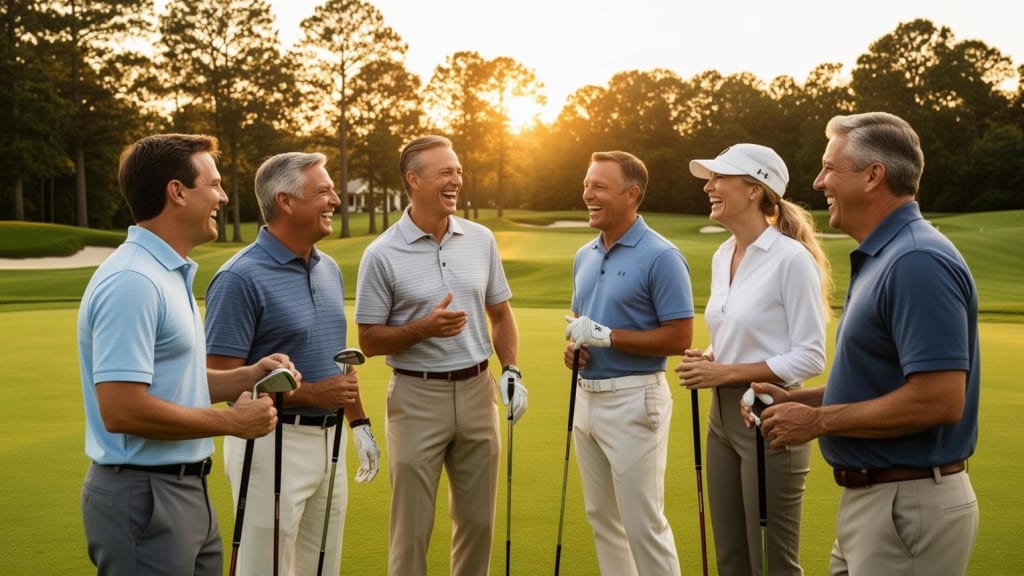
Golf has several characteristics that make it suitable for building relationships.
A round can take several hours.
Players spend time walking or traveling together between shots.
The pace creates opportunities for conversation.
Unlike a crowded conference where conversations may last only a few minutes, golf can offer extended informal interaction.
That is one reason businesspeople sometimes use the sport to build relationships with clients, colleagues, and professional contacts.
A golf game may provide opportunities for networking, although that does not mean every round involves negotiating deals or that relationships formed on a course necessarily produce business advantages.
Why the Social Environment Matters
Imagine two equally qualified professionals.
One has access to a private club frequently attended by senior business leaders.
The other does not.
The first person may encounter informal networking opportunities unavailable to the second.
That does not guarantee career success.
But it illustrates how economic resources can affect access to potentially useful social connections.
In Bourdieu's framework, this is one way economic capital can help create social capital.
How Much Does an Elite Golf Club Membership Cost in India?

One example frequently mentioned in discussions of elite sports is the DLF Golf and Country Club.
The private golf club is associated with an upscale residential and business environment in Gurugram.
Social media commentary sometimes claims that its membership costs begin at ₹20 lakh, equivalent to ₹2 million.
However, I could not verify ₹20 lakh as its current official joining fee from a publicly available club tariff.
Membership fees may vary by category, availability, corporate arrangements, and changes in club policy.
The ₹20 lakh figure should therefore not be published as a confirmed current minimum without an official quotation from the club.
That uncertainty does not undermine the broader argument.
Premium clubs can have substantial financial barriers.
But a specific price claim requires a verifiable source.
Does Everyone Need a Luxury Golf Membership?
No.
Golf can also be played through public courses, municipal facilities, driving ranges, beginner programs, and pay-per-round arrangements.
England Golf, for example, promotes inclusive programs designed to help people of different ages and backgrounds try the sport.
The cost of participating in golf therefore varies enormously.
Playing occasionally at an accessible public facility is very different from maintaining membership at a prestigious private country club.
The distinction is between access to the sport and access to the exclusive social institution surrounding the sport.
That is where the class argument becomes more precise.
Why Tennis Has an Elite Reputation Despite Being Widely Played Tennis has a complicated social history.

In nineteenth-century Britain, modern lawn tennis became popular among people who had access to gardens, private clubs, and leisure time.
Its association with upper- and middle-class social life contributed to an enduring image of elegance and refinement.
Traditional dress codes, exclusive clubs, and prestigious tournaments reinforced that perception.
But tennis is also played recreationally in public parks, schools, community centers, and affordable clubs across the world.
Playing Tennis and Belonging to an Elite Tennis Club Are Different Things
You do not need to be wealthy to hold a racket and play tennis.
However, reaching an elite competitive level may require significant resources.
Young athletes often need regular coaching, tournament travel, equipment, physical conditioning, and access to suitable facilities.
Families with greater financial resources may find it easier to support these commitments.
This creates potential inequalities in development opportunities even when the basic game is accessible.
Wimbledon and the Image of Prestige
Wimbledon is strongly associated with tradition, formal presentation, and prestigious sponsorships.
Its all-white clothing rules and carefully maintained grass courts contribute to its distinctive identity.
These traditions help differentiate the event from other tournaments.
But they do not establish that the sport itself exists solely for wealthy people.
Tennis remains accessible in many settings far removed from Wimbledon's private institutional environment.
Why Rolex Sponsors Wimbledon: What Luxury Branding Reveals About Sport
One detail in the original argument is correct: Rolex has a longstanding relationship with Wimbledon.
The Swiss watchmaker became the tournament's Official Timekeeper in 1978.
Wimbledon's official website describes the partnership in terms of precision, excellence, tradition, and achievement.But what does that sponsorship tell us about class?
Luxury Brands Sell More Than Products
A luxury watch does more than tell time.
For some consumers, it can communicate craftsmanship, achievement, heritage, and status.
Association with a prestigious sporting event can reinforce those qualities.
Wimbledon offers a globally recognized setting combining sporting excellence with tradition and exclusivity.
That makes the partnership understandable from a brand-positioning perspective.
Sponsorship Is Not Proof of Who Plays a Sport
There is an important difference between a tournament's marketing image and the economic background of its participants or viewers.
Millions of people watch Wimbledon without owning luxury watches or belonging to private tennis clubs.
Similarly, people from modest-income households can play tennis even if the tournament attracts premium advertisers.
The sponsorship supports the interpretation that Wimbledon has considerable prestige value.
It does not prove that tennis was invented or maintained exclusively to exclude the middle class.
Polo: Where Financial Barriers Become Particularly Visible
Polo presents a much stronger example of a sport with substantial participation costs.
Unlike tennis, which can be played with a racket, balls, and access to a court, polo requires trained horses, riding facilities, specialist equipment, and substantial animal care.
At competitive levels, players generally need access to multiple horses.
These costs can create barriers that are difficult for ordinary households to overcome.
Does Playing Polo Really Require a ₹50 Lakh Horse?
Not necessarily.
A 2025 Business Standard report estimated that trained polo ponies in India could cost approximately ₹8 lakh to more than ₹50 lakh, depending on quality and training.
Other expenses include stabling, transport, equipment, veterinary care, and competition fees.
So while ₹50 lakh can be a realistic price for an expensive polo horse, it is not a mandatory minimum.
Nor does everyone who learns polo need to purchase a horse.
Some clubs offer lessons using club-owned animals.
The Real Cost Is More Than One Horse
Competitive polo may require a string of multiple horses because animals are changed between periods of play.
A 2019 report on India's polo industry described the cost of a string of horses as ranging from roughly ₹50 lakh to ₹2 crore, depending on circumstances.
That is before considering every ongoing expense.
The financial burden helps explain why polo remains associated with wealthy families, established institutions, and corporate sponsorship.
It is one of the clearest examples of how the economic demands of a sport can influence who gets to participate.
Bourdieu's Concept of Habitus: Why We Often Choose What Feels Familiar
Perhaps the most interesting part of Bourdieu's theory is that social differences are not always imposed through explicit rules.
Sometimes people learn what feels natural or appropriate through their upbringing.
Bourdieu called this system of acquired dispositions habitus.
Habitus describes how our social experiences influence preferences, expectations, habits, and perceptions of what is possible.
Why One Child Imagines Cricket and Another Imagines Golf
Consider the children from the introduction.
The first child grows up surrounded by cricket.
Friends play it. Neighbors discuss it. Equipment is easy to improvise. Local role models provide examples to follow.
The second child grows up around golf and tennis.
Family members understand the rules. Club visits are familiar. Lessons begin early. Participation feels like an ordinary part of life.
Neither child's preferences must be consciously dictated.
Their environment helps shape what they encounter, learn, and imagine themselves doing.
This is what makes the relationship between class and leisure more complicated than simply asking whether someone can afford a racket.
An opportunity can be technically available while remaining socially unfamiliar or practically difficult to access.
Sports as Social Signals: What New Research Shows
Bourdieu's ideas continue to influence modern research.
A study published in Leisure Sciences in 2026 examined how people associate different sports with social status.
Researchers found that respondents tended to recognize golf, tennis, skiing, and equestrian activities as high-status sports.
By contrast, sports such as boxing, bowling, darts, and football were associated with lower social status within the study's classification.
Participants also attributed certain positive personal qualities to people associated with higher-status sports.
This is revealing because it suggests that sporting preferences can communicate social meaning even before people know anything about an individual's actual income.
A Hobby Can Become a Status Symbol
Imagine hearing that someone regularly attends a prestigious private golf club.
You might form assumptions about their economic position or social background.
Now imagine hearing that someone plays football every evening at a neighborhood field.
The associations may be different.
Neither activity establishes anyone's wealth, intelligence, character, or achievement.
But the fact that people form different impressions is exactly what makes sport relevant to the study of social distinction.
The Hidden Barriers: Money Is Only the Beginning
A private club may have a clear financial requirement.
But participation can also involve less visible barriers.
These may include cultural expectations, social familiarity, sponsorship, or simply knowing how admission works.
Someone may be able to afford a club's fees yet feel uncomfortable in its social environment.
Another person may have family connections that make the same environment feel completely ordinary.
Formal and Informal Barriers
Barrier | How it can affect participation |
|---|---|
Membership fees | Limits access based on financial resources |
Equipment costs | Makes participation more expensive |
Coaching expenses | Influences opportunities for skill development |
Location | Restricts access to people near suitable facilities |
Time availability | Favors people with flexible schedules |
Social networks | Can provide introductions or useful information |
Cultural familiarity | Affects comfort and confidence in unfamiliar settings |
Membership procedures | May advantage applicants who already understand the institution |
Not all clubs use every form of restriction.
Nor are all barriers deliberately created to exclude particular social classes.
Still, their combined effects can influence the social composition of sporting environments.
Why Rich People May Network Through Sports
Golf, polo, sailing, and similar activities can provide opportunities for extended social interaction.
People who repeatedly meet through leisure activities may build familiarity and trust.
Those relationships sometimes extend into professional life.
A corporate executive might meet a potential client during a golf round.
An entrepreneur might encounter an investor at a club event.
A family may develop long-term relationships with other members of the same institution.
The Difference Between Networking and Conspiracy
These connections do not prove that wealthy people collectively designed sporting institutions to exclude everyone else.
Social networks form in many environments, including schools, religious organizations, workplaces, neighborhood associations, and community sports clubs.
What makes exclusive leisure environments interesting is that financial or social access requirements can influence who participates in those networks.
When the participants already possess substantial economic resources, the relationships formed there may provide additional advantages.
That is a plausible mechanism through which social privilege can reproduce itself.
But it should not be converted into an unsupported claim that every private golf club is secretly a place where economic power is exchanged.
Cricket, Football, and the Myth of Completely Class-Free Sports

Cricket and football are often presented as more accessible alternatives to golf and polo.
There is some truth to that association.
Both games can be played informally with relatively limited resources.
A group of children may organize a cricket match using a tennis ball and improvised wickets.

Football requires little more than a ball and an available playing space.
But this does not mean professional pathways in these sports are free from economic inequalities.

Playing a Sport Is Different From Becoming a Professional
A child might play cricket almost every day without paying for coaching.
Yet pursuing a professional career may involve academy admission, equipment, travel, tournament fees, and years of structured training.
Families with greater financial resources may find it easier to support those commitments.
Similar challenges exist in football.
The cost of development can vary considerably by country and sporting institution.
Therefore, the distinction between elite and popular sports is not absolute.
It is more useful to ask which resources are needed at different levels of participation.
What About Sponsorship?
Cricket and football also attract luxury brands, financial institutions, technology companies, and premium advertisers.
The original comparison between Rolex at Wimbledon and supposedly more ordinary brands in cricket is too simplistic.
Brands sponsor events for many reasons, including audience size, geography, purchasing behavior, brand recognition, and marketing objectives.
A luxury sponsor does not prove that every spectator is wealthy.
Likewise, a mass-market sponsor does not establish that every participant belongs to the working class.
Are Middle-Class People Actually Excluded From Tennis and Golf?
No—not universally.
Public and community facilities provide meaningful alternatives to exclusive clubs.
For example, Britain's Lawn Tennis Association operates Barclays Free Park Tennis, which offers free organized tennis sessions with equipment provided.
Its wider Park Tennis Project has helped refurbish more than 2,500 courts across Britain through public and charitable investment.
Golf organizations also offer beginner programs and more accessible participation opportunities.
These initiatives demonstrate that the sports themselves are not inherently restricted to wealthy individuals.
However, access to recreational play does not automatically eliminate differences in professional coaching, elite club membership, competitive development, or social opportunities.
What Participation Research Says
Sport England acknowledges persistent socioeconomic inequalities in physical activity.
Its research finds that people in lower socioeconomic groups are more likely to be inactive than people in higher social groups.
That evidence supports the broader concern that financial and social circumstances influence participation.
But the inequality extends across different kinds of exercise and sport.
It is not exclusively a problem of tennis, golf, or polo.
How Sports Can Become More Accessible
The barriers associated with expensive sports are not necessarily permanent.
Governments, sporting organizations, schools, and local communities can reduce them.
Some particularly useful approaches include:
- Affordable public facilities: Municipal tennis courts, driving ranges, and pay-per-use options can reduce dependence on private clubs.
- Equipment-sharing programs: Loaned rackets, clubs, and other gear can lower the initial cost of trying a sport.
- Scholarships and subsidized coaching: Support can help talented athletes from lower-income households continue training.
- School-based programs: Introducing more sports through public education can expand familiarity beyond family backgrounds.
- Transparent membership policies: Clear pricing and admission requirements can reduce uncertainty and help applicants understand their options.
- Community partnerships: Clubs can work with schools and local organizations to create opportunities for new participants.
These measures will not eliminate every inequality.
But they can weaken the connection between family wealth and access to sporting opportunities.
The Bigger Question: Are Our Hobbies Really Our Own Choices?
The most provocative idea in Bourdieu's sociology is not that wealthy people play golf.
It is that our supposedly individual preferences are partly shaped by the opportunities and expectations surrounding us.
We often describe leisure activities as personal choices.
And they are, to an important extent.
But a choice is influenced by what we know exists, what we can afford, what our communities value, and where we feel welcome.
A child who has never encountered a tennis court is unlikely to develop the same familiarity with tennis as a child who plays every weekend.
A young adult who cannot afford riding lessons will have fewer opportunities to discover an interest in equestrian sports.
And someone who grows up around influential professional networks may learn social conventions that others must acquire later.
This does not mean people are prisoners of their upbringing.
People regularly cross social boundaries, learn unfamiliar skills, and develop interests that differ from their families.
But those journeys can involve unequal costs and opportunities.
Social class doesn't completely determine what we enjoy. It helps shape which possibilities are easiest to encounter and pursue.
Frequently Asked Questions About Sports and Social Class
Why are golf and tennis associated with rich people?
Golf and tennis have historical associations with private clubs, leisure time, specialized facilities, and prestigious institutions. Their social image has also been reinforced by exclusive events and luxury branding. However, both sports have public and affordable participation options.
What did Pierre Bourdieu say about sports?
Bourdieu argued that sporting preferences and participation are connected to social position, cultural capital, economic resources, and acquired habits. His work examined how leisure practices can express and reinforce class distinctions.
Is golf only for wealthy people?
No. Golf can be played through public courses, driving ranges, beginner programs, and pay-per-round facilities. However, membership at exclusive private clubs can be expensive and may provide social experiences unavailable through ordinary recreational facilities.
Do you need to own an expensive horse to play polo?
No. Some polo clubs offer lessons with club-owned horses. Nevertheless, competitive participation can be extremely expensive because it may require access to several trained horses, stabling, transport, specialized equipment, and ongoing veterinary care.
The Real Class Divide in Sports Isn't Just About Who Can Play
There is something revealing about how society assigns prestige to different hobbies.
A person playing golf at an exclusive country club may be seen as sophisticated or successful.
Someone playing football in a neighborhood park may be seen quite differently.
Yet both are simply participating in sport.
The difference lies partly in the meaning society attaches to their activities.
Pierre Bourdieu helped explain why those meanings are rarely independent of social class.
Money can determine access to facilities.
Cultural familiarity can influence where someone feels comfortable.
Social connections can turn recreational environments into networks of opportunity.
And the prestige associated with particular activities can reinforce existing distinctions between groups.
But the argument becomes weaker when it relies on exaggeration.
Middle-class people do play tennis and golf.
Polo does not universally require purchasing a ₹50 lakh horse.
The frequently repeated ₹20 lakh DLF Golf Club membership figure should not be stated as a confirmed current fee without official verification.
And Rolex's relationship with Wimbledon reflects luxury branding and the tournament's prestige, not proof that everyone who watches or plays tennis belongs to the upper class.
The more important truth is subtler.
A sport can be open to everyone in principle while its most prestigious spaces remain much easier for wealthy people to access.
That distinction matters because access to a game and access to the social opportunities surrounding it are not necessarily the same thing.
A public tennis court can provide recreation, exercise, and friendship.
A private country club may provide those benefits while also offering entry into an established professional network.
Both involve sport.
But the surrounding opportunities may be very different.
Ultimately, the question is not whether wealthy people should be allowed to enjoy golf, tennis, or polo.
Of course they should.
The question is whether family income and social background should play such an important role in determining who gets access to facilities, training, and opportunities.
And perhaps the most useful insight from Bourdieu is this:
We don't choose our hobbies in a social vacuum. We choose from a world of possibilities that our circumstances have already helped shape.
The next time someone describes a sport as sophisticated, prestigious, or exclusive, ask what gives it that reputation.
Is it the skill required to play?
Its history?
Its cultural image?
Or the people who can afford to participate at its most privileged level?
Understanding the difference tells us something not only about sport—but also about the way social inequality can hide inside the ordinary choices of everyday life.