
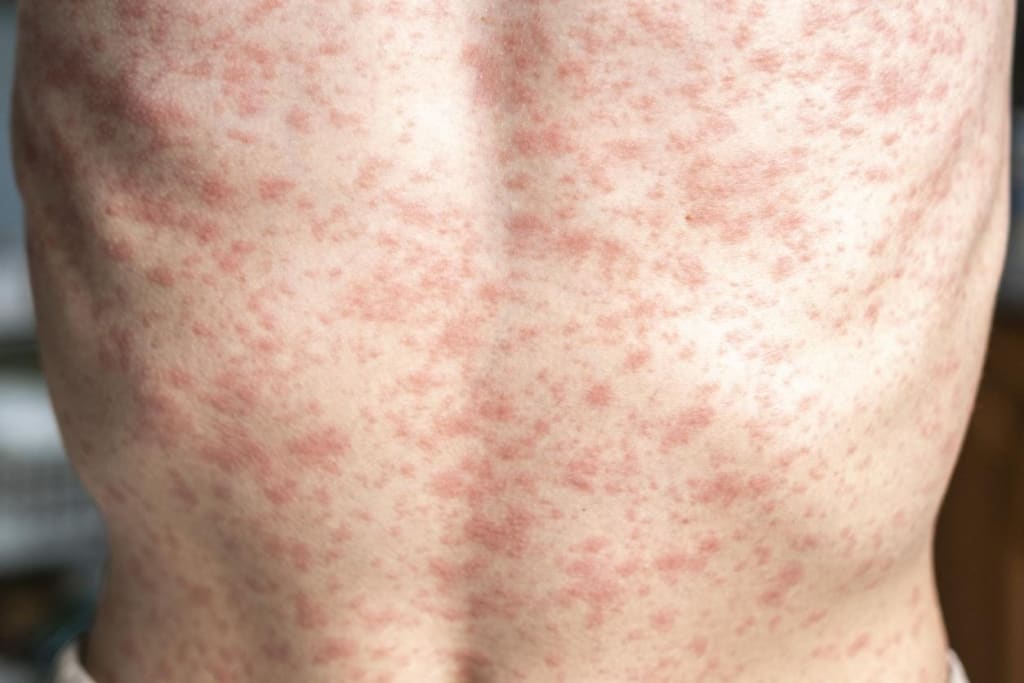
U.S. Measles Cases Hit a 35-Year High as Outbreaks Keep Spreading
Measles was declared eliminated from the United States more than a quarter-century ago.
Now America is experiencing its largest measles surge in 35 years.
The latest published CDC count shows 3,471 confirmed measles cases in the United States in 2026 as of September 17, already far exceeding the 2,289 cases reported during all of 2025. Ninety-five percent of this year's cases are associated with outbreaks, and infections have been reported across 47 jurisdictions.
And even that number is already behind some state-level reporting.
Pennsylvania, currently experiencing one of the country's most serious outbreaks, reported 835 confirmed cases by September 23, along with 164 hospitalizations and four measles-associated deaths. Wisconsin had reached 171 confirmed cases by September 22, while Ohio had reported 180 cases through mid-September.
The numbers have become serious enough to raise an uncomfortable question:
Could the United States lose the measles elimination status it has held since 2000?
That possibility is now under formal review.
And the answer may come in November 2026.
The U.S. Measles Count Has Already Moved Beyond 3,294
The measles outbreak is developing quickly enough that figures can become outdated within days.
On September 10, the CDC reported 3,294 confirmed cases.
One week later, the national total had climbed to:
3,471 confirmed cases as of September 17.
That means another 177 confirmed infections were added to the CDC total in only seven days.
The CDC also reported:
39 outbreaks during 2026.
And of the 3,471 confirmed cases, 3,296—or 95%—were outbreak-associated.
That detail is important.
This is no longer primarily a situation in which isolated infected travelers arrive from overseas, infect one or two people, and public health authorities quickly stop transmission.
Large chains of domestic transmission are occurring.
That is exactly what threatens elimination status.
This Is the Highest U.S. Measles Total Since 1991
To understand why 2026 is so significant, go back to the last major American measles resurgence.
The United States recorded 27,786 cases in 1990 and another 9,643 in 1991.
Then cases collapsed.
Only about 2,200 were reported in 1992.
Numbers subsequently fell much further as vaccination coverage and outbreak control improved.
By 2000, sustained domestic measles transmission had been interrupted enough for the disease to be officially declared eliminated in the United States.
Now compare those numbers with 2026.
With 3,471 confirmed cases already reported by September 17, the country has surpassed every annual total since 1991.
That makes the current outbreak the largest U.S. measles resurgence in 35 years.
And 2026 is not over.
The Rise From 2024 Has Been Remarkable
The speed of the resurgence is almost as important as the absolute number.
The United States recorded only 285 measles cases in 2024.
Then came 2025:
2,289 cases.
And by September 17, 2026:
3,471 cases.
In other words, the country went from fewer than 300 confirmed infections to thousands in just two years.
The 2026 total is already more than 50% higher than the entire 2025 total.
And because CDC figures contain confirmed cases that states have formally reported to the agency, the national number can lag behind more rapidly updated state dashboards.
Pennsylvania provides a dramatic example.
Pennsylvania's Outbreak Is Growing Extremely Quickly
On September 4, Pennsylvania reported 577 confirmed measles cases across 37 counties.
Less than three weeks later, on September 23, the state reported:
835 cases across 39 counties.
That is an increase of 258 confirmed cases in just 19 days.
Pennsylvania also reported 164 hospitalizations and four measles-associated deaths by September 23. Only four of its 835 confirmed cases were among people whom the state described as appropriately vaccinated for their age.
The growth has prompted a large vaccination response.
Pennsylvania health officials reported that more than 38,000 MMR doses were administered during the first three weeks of September alone, compared with about 25,000 in a typical month. State-organized pop-up clinics had administered nearly 5,200 additional doses since the outbreak began in late April.
The numbers show both sides of an outbreak response.
Cases can rise rapidly once measles reaches susceptible communities.
But vaccination demand can rise rapidly too when people recognize the danger.
Wisconsin Went From a Few Cases to More Than 170
Wisconsin provides another example of how quickly measles can accelerate.
On August 11, state authorities announced what were only the third and fourth confirmed Wisconsin cases of 2026.
Officials were already concerned because some infections appeared to have been acquired inside Wisconsin rather than during travel, suggesting unidentified community transmission could be occurring.
By September 22, Wisconsin had confirmed:
171 measles cases.
The largest cluster was centered in Grant, Iowa, Lafayette and Vernon counties in southwestern Wisconsin, where state officials said measles was spreading locally.
That progression—from four known cases in early August to more than 170 by late September—is a reminder of what makes measles fundamentally different from many other infectious diseases.
It spreads extraordinarily efficiently.
Ohio Is Also Seeing a Sharp Increase
Ohio has experienced multiple measles outbreaks during 2026.
At the end of July, the state had reported just 15 cases for the year and announced its third outbreak.
By September 15, the total had climbed to approximately:
180 confirmed cases.
That compared with only 45 cases during all of 2025 and seven during 2024. Most of the 2026 cases were concentrated in northeastern Ohio.
The trajectory is striking.
Fifteen cases at the end of July.
Ninety-nine by August 20.
One hundred twenty-two by September 3.
One hundred eighty by mid-September.
Measles outbreaks can appear manageable and then accelerate rapidly once the virus reaches a community containing enough susceptible people.
The Real Number of Measles Cases May Be Higher
Confirmed case counts are not necessarily the same thing as the true number of infections.
The CDC national dashboard includes confirmed cases formally reported by jurisdictions. It also notes that states may separately report probable cases that are not yet included in the national confirmed total.
Wisconsin health officials have made another important point:
Not everyone who becomes sick seeks medical attention.
And not everyone with symptoms is tested.
Therefore, public health departments may never learn about every infection occurring in a community.
This does not mean anyone can reliably estimate how many cases are being missed.
But it does mean the confirmed count should be understood as the number authorities have documented—not necessarily every person who has contracted measles.
Why Can Measles Spread So Fast?
Because measles is one of the most contagious human diseases known.
The virus spreads through the air when an infected person breathes, coughs or sneezes.
It can remain infectious in an indoor airspace for up to two hours after the infected person has left.
And among people without immunity who are close to someone with measles, the CDC says as many as 90% may become infected.
An infected person can also spread the virus before realizing what is happening.
People with measles are generally contagious from about four days before the rash appears until four days afterward.
That creates an enormous advantage for the virus.
Someone may attend school, work, a religious gathering, an airport, a healthcare facility or a family event while infectious but before the characteristic rash appears.
By the time measles is recognized, many exposures may already have occurred.
Measles Is Much More Than a Rash
Because vaccination made measles uncommon in the United States for decades, many people have little direct experience with the disease.
That can make measles sound less dangerous than it is.
The illness usually begins with high fever, cough, runny nose and red or watery eyes. Small white Koplik spots may develop inside the mouth, followed several days later by the characteristic rash that commonly begins around the face and spreads downward.
Most people recover.
But serious complications occur.
According to the CDC, approximately one in five unvaccinated Americans who develops measles may require hospitalization.
Around one in 20 children with measles develops pneumonia.
Approximately one in every 1,000 children develops encephalitis, or brain swelling.
And historically, roughly one to three children per 1,000 measles infections have died from respiratory or neurological complications.
There is also a rare delayed neurological disease called subacute sclerosing panencephalitis, or SSPE, which can emerge years after the original measles infection and is fatal.
Measles can additionally damage parts of the immune system's memory, temporarily increasing vulnerability to other infections even after the original disease has resolved.
So describing measles simply as a childhood rash dramatically understates the disease.
Vaccination Coverage Has Fallen Below the 95% Target
The central problem is not that the measles vaccine suddenly stopped working.
It remains highly effective.
According to the CDC:
One MMR dose is approximately 93% effective against measles.
Two doses are approximately 97% effective.
The problem is population coverage.
Measles is so contagious that communities generally need vaccination levels around 95% to maintain strong population-level protection.
U.S. kindergarten MMR coverage was 95.2% during the 2019–2020 school year.
By the 2025–2026 school year, it had fallen to:
92.4%.
The CDC estimates that this leaves approximately 280,000 kindergarteners at risk during the current school year.
And the national percentage hides an even more important problem.
Vaccination is not distributed evenly.
A state could theoretically report reasonably high overall vaccination while individual counties, schools, religious communities or neighborhoods have much lower coverage.
Those pockets of susceptibility are exactly where measles can spread explosively.
Why 95% Matters So Much for Measles
Different infectious diseases require different levels of population immunity to suppress transmission.
Measles is unusually demanding because it spreads so effectively.
If almost everyone around an infected traveler is immune, transmission reaches dead ends.
One infected person may expose dozens of people, but few become infected.
The outbreak stops.
Now imagine the same infected traveler entering a community where a significant number of people lack immunity.
Suddenly the virus has pathways.
One infection becomes several.
Several become dozens.
Those infections generate more exposures.
And because people can spread measles before the rash appears, public health authorities are always working partly backward—identifying where an infected person has already been.
That is why seemingly small declines in vaccination coverage can matter enormously.
The national difference between 95.2% and 92.4% may look like only 2.8 percentage points.
For measles, those percentage points can represent hundreds of thousands of additional susceptible children and much larger vulnerabilities inside particular communities.
Imported Measles Is Not the Same as Endemic Measles
There is another misconception worth clearing up.
When the United States declared measles eliminated in 2000, that did not mean America would never record another measles case.
"Elimination" is not the same thing as global eradication.
Measles continues circulating internationally.
Travelers can become infected overseas and bring the virus into the United States.
That has happened repeatedly since 2000.
As long as those introductions produce limited outbreaks that are eventually interrupted, the country can retain elimination status.
The key issue is whether the virus establishes continuous domestic transmission.
That distinction is now at the center of the 2026 debate.
The U.S. Could Lose Its Measles Elimination Status
The Pan American Health Organization's Regional Verification Commission defines re-establishment of endemic measles transmission as an uninterrupted chain involving the same viral genotype and lineage lasting 12 months or longer within a country.
The relevant U.S. outbreak analysis begins on:
January 20, 2025.
That means the 12-month threshold has already been crossed chronologically.
But losing elimination status is not determined simply by looking at a calendar.
Investigators need epidemiological and molecular evidence showing whether infections represent one continuous transmission chain or multiple separate introductions.
That can require detailed outbreak investigations and viral genome sequencing.
PAHO has said U.S. authorities are conducting exactly that type of analysis, including complete viral genome sequencing and development of tools for detailed molecular comparisons.
The formal review of the United States' status is now scheduled for November 2026 during the regular annual meeting of the Regional Verification Commission.
What Would Losing Elimination Status Actually Mean?
It would not mean measles had suddenly returned everywhere in America.
It would not mean vaccination had failed.
And it would not mean the United States had returned to the pre-vaccine era.
The technical meaning is much more specific.
It would indicate that evidence shows measles has once again established sustained endemic transmission inside the country rather than appearing only through imported infections followed by limited transmission.
Symbolically, however, losing the designation would be significant.
The United States achieved elimination in 2000 after decades of vaccination campaigns and public health work.
Before widespread vaccination, measles infected millions of Americans in a typical year.
The CDC estimates that before the vaccine era, around 48,000 people were hospitalized and 400 to 500 died annually from measles in the United States.
Elimination therefore represented one of the major achievements of modern American public health.
Re-establishment of endemic transmission would mark a substantial reversal.
There Is Another Important Distinction: The Americas Already Lost Regional Elimination Status
The U.S. decision should not be confused with what has already happened across the Americas.
In November 2025, the Region of the Americas lost its status as free of endemic measles transmission after authorities determined that Canada had experienced uninterrupted viral circulation for at least 12 months.
Individual countries can still retain their own elimination classifications.
The question now is whether evidence shows the United States has crossed the same line.
PAHO's November 2026 review will examine both the United States and Mexico, along with the wider regional situation.
This Is Part of a Much Larger Measles Resurgence
America's outbreak is not occurring in isolation.
Measles has been increasing across much of the Western Hemisphere.
By September 5, PAHO had recorded 52,676 confirmed measles cases across 17 countries and territories in the Americas during 2026, approximately 3.8 times the number reported during the same period in 2025.
Guatemala, Mexico, the United States, Peru and Canada accounted for almost all of those cases.
Earlier in August, PAHO classified the public health risk from measles in the Americas as very high, pointing to continuing outbreaks, immunity gaps and increased population movement.
This matters for the United States because measles anywhere creates opportunities for importation everywhere.
International travel can repeatedly introduce the virus.
High vaccination coverage prevents those introductions from becoming sustained outbreaks.
Low coverage gives them somewhere to spread.
Are Vaccinated People Getting Measles Too?
Yes, occasionally.
No vaccine provides 100% protection.
The CDC estimates that one dose of MMR prevents about 93% of measles infections and two doses prevent approximately 97%.
Therefore, when millions of vaccinated people coexist with a large outbreak, some breakthrough infections are mathematically expected.
What matters is the distribution of cases.
Pennsylvania's September 23 update reported that only four of its 835 confirmed cases—less than 1%—were among people the state classified as appropriately vaccinated for their age.
National CDC data similarly show that the great majority of reported infections occur among people who are unvaccinated or whose vaccination status is unknown.
A small number of breakthrough cases therefore does not indicate that the MMR vaccine has stopped working.
It is exactly what would be expected from a vaccine that is highly effective but not perfect.
What About the Reported Measles Deaths?
The death figures require careful interpretation because state and federal reporting were not completely aligned in September.
Pennsylvania had classified four deaths as measles-associated by September 23.
The CDC's national page, however, displayed one death in its September reporting and specifically noted that the figure was subject to change.
The CDC also said it was working with the Council of State and Territorial Epidemiologists to create a standardized definition for classifying deaths due to measles.
This is why different reputable sources can currently display different mortality totals.
It does not necessarily mean one source is ignoring cases or another is fabricating them.
Public health surveillance sometimes distinguishes between a death occurring in someone with measles, a measles-associated death and a death determined to have been directly caused by measles.
Those classifications can require medical record review and standardized criteria.
What Should Someone Do After a Possible Measles Exposure?
Because measles spreads so easily, someone who thinks they have been exposed should contact a healthcare provider promptly rather than simply walking into a crowded clinic or emergency department.
The CDC specifically recommends calling ahead.
Healthcare facilities can then arrange evaluation without unnecessarily exposing other patients and staff.
People should also seek medical guidance if they develop the classic combination of fever, cough, runny nose, red eyes and a spreading rash—particularly after known exposure or travel to an area experiencing an outbreak.
Vaccination decisions depend on age, previous doses, immunity, pregnancy status and certain medical conditions, so people uncertain about their MMR history should discuss their individual situation with a healthcare professional.
The Most Important Number May Not Be 3,471
The headline number is dramatic.
3,471 confirmed U.S. measles cases.
The highest annual total in 35 years.
But another number may ultimately matter more:
92.4%.
That is the national kindergarten MMR coverage reported for the 2025–2026 school year.
Measles has not fundamentally changed.
The MMR vaccine has not suddenly stopped working.
What has changed is the number and geographic concentration of susceptible people available for the virus to infect.
When vaccination coverage remains high, an imported measles infection encounters biological dead ends.
When immunity gaps become large enough, those dead ends turn into transmission chains.
Pennsylvania demonstrates how quickly that transition can happen.
Wisconsin demonstrates it.
Ohio demonstrates it.
And the nationwide numbers demonstrate it.
November 2026 Could Become a Historic Moment for U.S. Public Health
For more than 25 years, the United States has maintained that endemic measles transmission no longer exists within its borders.
Imported cases happened.
Outbreaks happened.
Some were substantial.
But transmission was eventually interrupted.
The outbreaks of 2025 and 2026 have created a different challenge.
PAHO's verification commission will now examine whether a continuous chain has survived long enough to mean measles has once again become endemic in the United States.
That review is scheduled for November.
Until then, describing the U.S. as having already lost its elimination status would be premature.
But dismissing the possibility would also ignore the seriousness of the current situation.
The country has already recorded its highest measles case count since 1991.
State outbreaks are continuing.
Vaccination coverage among kindergarteners has fallen below the level generally needed for strong community protection.
And nearly all current cases are connected to outbreaks rather than isolated introductions.
The disease America officially eliminated in 2000 has not yet officially returned as endemic.
But in 2026, the possibility is no longer theoretical.
Frequently Asked Questions
How many measles cases have been reported in the U.S. in 2026?
The latest published CDC national total is 3,471 confirmed cases as of September 17, 2026. Because state health departments update on different schedules, more recent state figures mean the real-time nationwide total is already higher than that published CDC snapshot.
Is 2026 the worst U.S. measles year in decades?
Yes. The 2026 total is already the highest since 1991, when the United States recorded 9,643 cases. Approximately 2,200 cases were reported in 1992, meaning the 2026 count has exceeded every year since 1991.
How many measles cases does Pennsylvania have?
Pennsylvania reported 835 confirmed cases across 39 counties as of September 23, 2026, with 164 hospitalizations and four measles-associated deaths.
How many measles cases does Wisconsin have?
Wisconsin reported 171 confirmed cases as of September 22, 2026, with most associated with an outbreak in southwestern Wisconsin.
How many measles cases does Ohio have?
Ohio had reported approximately 180 confirmed cases through September 15, 2026, up dramatically from 15 cases at the end of July.
Why are U.S. measles cases rising?
The CDC identifies declining MMR vaccination coverage, concentrated pockets of unvaccinated people and increased measles circulation globally as important factors. U.S. kindergarten MMR coverage has fallen from 95.2% in 2019–2020 to 92.4% in 2025–2026.
How effective is the MMR vaccine against measles?
One dose is approximately 93% effective, while two doses are approximately 97% effective at preventing measles.
Can vaccinated people still catch measles?
Yes, but breakthrough infection is uncommon because two MMR doses are approximately 97% effective. During large outbreaks, some vaccinated people will inevitably be exposed and a small percentage can become infected.
Is measles highly contagious?
Extremely. The CDC says that up to 90% of susceptible people close to an infected person may become infected. The virus can also remain infectious in an indoor airspace for up to two hours after the infected person leaves.
Is measles dangerous?
It can be. The CDC estimates that around one in five unvaccinated U.S. patients with measles is hospitalized. Complications can include pneumonia, encephalitis, pregnancy complications, long-term neurological disease and death.
Was measles eliminated from the United States?
Yes. The United States was declared to have eliminated endemic measles transmission in 2000. Imported cases and outbreaks have continued to occur since then, but elimination means sustained domestic transmission had been interrupted.
Has the U.S. already lost its measles elimination status?
No final determination has been announced. PAHO's Regional Verification Commission is scheduled to review the United States' elimination status in November 2026.
What would make the United States lose measles elimination status?
PAHO defines re-establishment of endemic transmission as an uninterrupted chain involving the same measles virus genotype and lineage continuing for 12 months or longer within a country. Epidemiological investigations and genetic sequencing are used to determine whether that standard has been met.
Why might the true number of measles infections be higher?
National statistics count confirmed cases reported to public health authorities. Some infected people may not seek healthcare or be tested, while probable cases may not yet appear in the CDC's confirmed total. Wisconsin health officials specifically warned that public health agencies may therefore not know about every infection occurring in a community.
What should someone do if they think they were exposed to measles?
The CDC recommends contacting a healthcare provider immediately. People should call ahead before visiting a clinic or hospital so staff can arrange evaluation without exposing other patients.


