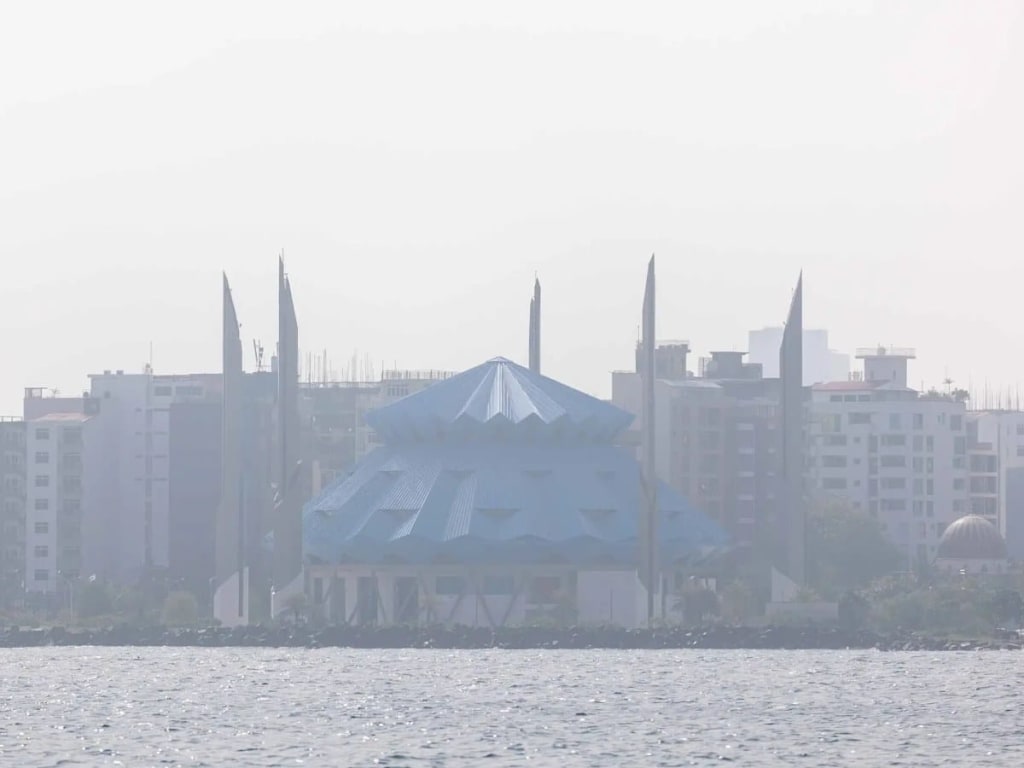
Unusual Fog in Maldives Is Actually Air Pollution: Why Toxic Haze Is Covering the Island Paradise
The Maldives, famous for its crystal-clear lagoons, turquoise waters, white-sand beaches, and stunning tropical scenery, is experiencing an unsettling environmental phenomenon: a thick layer of haze that makes parts of the island nation appear unusually foggy.
But the grey atmosphere affecting Malé and several other islands is not simply ordinary morning fog.
Much of the reduced visibility is associated with air pollution haze containing fine particulate matter, including particles that can penetrate deep into the lungs and pose health risks.
On November 21, 2026, air-quality monitoring reports showed that pollution had reached unhealthy levels in several parts of the Maldives.
According to figures reported from IQAir monitoring data, the Air Quality Index reached approximately 159 in Malé, 160 in Villimalé, and 165 in Kulhudhuffushi.
These values fall within the unhealthy category of the commonly used U.S. Air Quality Index scale, indicating conditions that can affect the general population, particularly people with respiratory or cardiovascular vulnerabilities.
The Maldives Meteorological Service has also warned that hazy conditions may persist across parts of the country for several days, with northern and central atolls potentially experiencing worsening conditions.
The timing is significant.
Every year, as the southwest monsoon gives way to the northeast monsoon, wind patterns across South Asia change.
These seasonal winds can transport polluted air over enormous distances, carrying fine particles from industrial activity, agricultural burning, construction, and other sources across the Indian Ocean.
As a result, even remote tropical islands can experience air pollution generated hundreds or thousands of kilometers away.
The latest event demonstrates a difficult environmental reality.
Living far from major industrial cities does not necessarily guarantee clean air.
But where exactly is the Maldives haze coming from?
How dangerous are the microscopic particles suspended in the atmosphere?
And why does this problem return during particular seasons?
Understanding the answers requires examining atmospheric science, South Asian air pollution, monsoon circulation, and the health risks associated with PM2.5.
Maldives Air Pollution in November 2026: What Is Happening?
The latest haze episode has affected visibility and air quality across the Maldives, including the Greater Malé region and northern atolls.
Reports published on November 19 described worsening visibility as the country approached its northeast monsoon season.
By November 21, several monitoring locations had registered unhealthy air-quality readings.
The Maldives Meteorological Service reported that the haze could continue for approximately five days from November 21, with possible intensification in northern and central regions during the following three days.
These forecasts describe expected conditions rather than guaranteed outcomes.
Air quality can change rapidly depending on wind direction, rainfall, atmospheric mixing, and local emissions.
Latest Reported Air-Quality Readings
| Location | Reported AQI | Air-Quality Category |
|---|---|---|
| Kulhudhuffushi | 165 | Unhealthy |
| Villimalé | 160 | Unhealthy |
| Malé | 159 | Unhealthy |
Source: IQAir readings reported by Maldives Media TV on November 21, 2026. These are time-specific measurements, not permanent air-quality conditions.
The readings attracted attention because the Maldives is usually associated with clear ocean air rather than the heavy pollution commonly seen in major South Asian cities.
However, the country's location does not isolate it from atmospheric pollution transported from other regions.
Seasonal changes in wind patterns can carry polluted air across the Arabian Sea and surrounding waters.
Local events can also worsen conditions.
During the November 2026 haze episode, a fire at a waste collection area in Hulhumalé Phase 3 added smoke affecting parts of Hulhumalé Phase 2.
That local source should be distinguished from the wider regional haze affecting the country.
Is It Fog or Haze? Understanding the Difference
When visibility decreases and the horizon disappears behind a whitish or grey atmospheric layer, people often describe the scene as fog.
But fog and pollution haze are different phenomena.
What Is Natural Fog?
Fog consists primarily of tiny water droplets or, under some conditions, ice crystals suspended near the ground.
It forms when air becomes sufficiently humid and cool for water vapor to condense.
Fog is common in many environments, particularly during calm conditions when temperatures approach the dew point.
Although dense fog can disrupt transportation, it is not necessarily evidence of elevated particulate pollution.
What Is Air Pollution Haze?
Haze occurs when suspended particles or other atmospheric constituents reduce visibility.
Pollution haze may contain particles from:
- Vehicle exhaust.
- Industrial emissions.
- Burning agricultural residues.
- Forest and vegetation fires.
- Dust from roads and construction.
- Combustion of coal and other fuels.
- Chemical reactions involving airborne gases.
These particles scatter and absorb sunlight, making the atmosphere appear cloudy, grey, or unusually opaque.
Humidity can make some pollution particles absorb water and grow larger, further reducing visibility.
This means the atmosphere can look foggy even when the main concern is particulate pollution rather than ordinary condensation.
Fog vs Haze: Key Differences
| Feature | Natural Fog | Air Pollution Haze |
|---|---|---|
| Main cause | Suspended water droplets | Suspended particles and pollutants |
| Typical appearance | White or grey cloud near ground | Whitish, grey, or brownish atmosphere |
| Visibility | Can become extremely limited | Often reduced over a wide region |
| Health concern | Usually related to visibility and associated conditions | May involve respiratory and cardiovascular risks |
| Main measurements | Visibility, humidity, temperature | PM2.5, PM10, AQI and other pollutants |
| Common response | Transportation precautions | Exposure reduction and air-quality monitoring |
Fog and haze can also occur together.
Therefore, visual appearance alone cannot precisely identify what is present in the air.
Air-quality monitoring provides the more useful evidence.
What Is PM2.5 and Why Is It Dangerous?
One of the most important pollutants associated with haze is PM2.5, meaning particulate matter with an aerodynamic diameter of 2.5 micrometers or smaller.
A micrometer is one-millionth of a meter.
These particles are far smaller than the width of a typical human hair.
Because they are so small, they can remain suspended in the atmosphere and travel considerable distances.
They can also penetrate deep into the respiratory system when inhaled.
Where Does PM2.5 Come From?
Fine particulate pollution comes from multiple sources.
Some particles are emitted directly during combustion.
Others form in the atmosphere when gases such as sulfur dioxide, nitrogen oxides, and ammonia undergo chemical reactions.
Common human-generated sources include power generation, transportation, industrial production, agricultural burning, and household fuel use.
Natural sources, including wildfires and windblown dust, can also contribute.
The exact composition of PM2.5 varies depending on where it originates and how long it has traveled through the atmosphere.
How Fine Particles Affect the Human Body
When someone inhales polluted air, larger particles are often trapped within the upper respiratory tract.
Smaller particles can travel farther into the lungs.
PM2.5 can reach the alveoli, the tiny air sacs where oxygen and carbon dioxide are exchanged.
Exposure can trigger inflammation and oxidative stress.
Some particle components or associated substances may cross into the circulation, while broader biological responses can affect the cardiovascular system.
Long-term exposure is associated with increased risks of several serious health conditions.
These include cardiovascular disease, stroke, chronic respiratory illness, and lung cancer.
Short-term exposure can also worsen symptoms in people with asthma and other respiratory conditions.
This is why fine particulate pollution is considered a major public-health concern.
The 41.3 µg/m³ PM2.5 Reading: What Does It Really Mean?
A previous Maldives haze report, published on December 10, 2025, described a PM2.5 concentration of 41.3 micrograms per cubic meter.
The report noted that this was approximately 8.3 times the World Health Organization's annual PM2.5 guideline level.
That comparison is mathematically correct.
The WHO's recommended annual average guideline for PM2.5 is 5 µg/m³.
Dividing 41.3 by 5 gives approximately 8.26.
However, the comparison requires context.
WHO Air Quality Guidelines
| Measurement | WHO Recommended Level |
|---|---|
| PM2.5 annual average | 5 µg/m³ |
| PM2.5 24-hour average | 15 µg/m³ |
| PM10 annual average | 15 µg/m³ |
| PM10 24-hour average | 45 µg/m³ |
These values come from the WHO's 2021 Global Air Quality Guidelines.
The guidelines are health-based reference levels, not boundaries below which pollution becomes completely harmless.
The annual guideline is intended for long-term exposure assessment.
The 24-hour guideline addresses shorter-term concentrations.
Why the Historical Reading Matters
The 41.3 µg/m³ figure demonstrates that the Maldives has previously experienced considerably elevated fine-particle concentrations.
However, it should not be presented as a verified live reading for November 22, 2026.
The latest reporting instead provides AQI values from November 21.
An AQI score and a PM2.5 concentration are not interchangeable.
AQI is a standardized index calculated from pollutant concentrations according to a defined scale.
PM2.5 concentration is a physical measurement expressed in micrograms per cubic meter.
Confusing the two can lead to misleading claims about current exposure.
Why Is the Maldives Experiencing Haze During the Monsoon Transition?
One of the most important causes of seasonal haze in the Maldives is the change in regional wind patterns.
The country experiences two broad monsoon seasons.
The southwest monsoon, commonly known as Hulhangu, generally dominates during the wetter part of the year.
The northeast monsoon, known locally as Iruvai, usually brings different wind patterns and is associated with the drier season.
The transition between these seasons can alter the direction and origin of air masses reaching the islands.
How Northeast Monsoon Winds Transport Pollution
During the northeast monsoon, prevailing winds can carry air from the South Asian mainland toward the Indian Ocean.
That air may contain pollution generated over densely populated and industrialized regions.
The particles can be transported over large distances before reaching the Maldives.
This process is called long-range atmospheric transport.
It explains why pollution generated in one country can affect air quality in another.
The islands do not need to contain enormous factories or large numbers of vehicles to experience polluted air.
Their exposure can be influenced by emissions far beyond their national borders.
Why the Transition Period Can Be Especially Noticeable
As monsoon patterns change, air circulation and atmospheric stability can vary.
The movement of dry continental air toward oceanic regions may increase the transport of dust, smoke, and other particles.
Local weather conditions may also influence how effectively pollutants disperse.
Rainfall can remove some particles from the air, while periods without rain may allow pollution to persist.
The exact relationship varies between events.
That is why scientists rely on meteorological observations and atmospheric transport models rather than assuming that every hazy day has the same cause.
Is the Pollution Coming From India and the Himalayan Region?
Regional reporting frequently identifies northern India and surrounding parts of South Asia as important sources of pollution transported toward the Maldives.
These regions experience substantial seasonal air-pollution problems associated with industrial activity, transportation, agricultural burning, dust, and other emissions.
During particular atmospheric conditions, pollution can travel southward over the Indian Ocean.
However, attributing an entire haze episode to one precise location requires evidence.
What About the Himalayas?
Some reports describe the pollution as arriving through winds associated with the Himalayan region.
This wording can create confusion.
The Himalayas are a vast mountain system extending across several countries.
The mountains are not themselves necessarily the direct source of the industrial smoke or particulate pollution reaching the Maldives.
More accurately, atmospheric circulation over South Asia can transport emissions from populated regions toward the ocean.
The pollution may originate from multiple areas rather than a single mountain range.
Agricultural Burning and Seasonal Pollution
Agricultural residue burning is one potential contributor to regional particulate pollution.
After harvests, some farmers burn remaining crop material to clear land.
These fires release smoke and fine particles.
Industrial and traffic emissions can mix with agricultural smoke, producing complicated pollution mixtures.
During favorable wind conditions, particles can travel far from their original sources.
But determining how much of a specific Maldives haze event comes from crop burning requires atmospheric analysis.
It should not be assumed that agricultural fires explain every episode.
Why Minicoy and Lakshadweep Matter
The island of Minicoy, part of India's Lakshadweep archipelago, lies north of the Maldives.
Its location makes it geographically relevant when examining air masses moving toward the northern Maldivian atolls.
If polluted air travels across the region, monitoring data from Minicoy and surrounding islands may provide useful context.
However, a high pollution reading near Minicoy does not necessarily mean Minicoy itself is generating the pollution.
The island may also be experiencing transported particles.
Understanding Regional Air Movement
Imagine a large cloud of fine particles generated over a mainland region.
Winds carry that polluted air toward the ocean.
As it travels, some particles settle or are removed by rainfall.
Others remain suspended and continue moving.
Island communities along the route may experience reduced visibility and elevated pollution even though local emissions are comparatively limited.
This is why transboundary air pollution requires cooperation between countries.
The atmosphere does not recognize national borders.
Local Pollution Sources Can Make the Maldives Haze Worse
Although transboundary pollution is an important part of the story, the Maldives also has local sources that affect air quality.
These include traffic, electricity generation, construction activity, waste handling, and occasional fires.
In densely developed areas such as Greater Malé, local emissions can combine with transported pollution.
Hulhumalé Waste-Site Fire in November 2026
During the latest haze episode, local reporting described smoke from a fire at a waste collection area in Hulhumalé Phase 3.
The smoke affected parts of Hulhumalé Phase 2.
The incident prompted the Health Protection Agency to advise precautions.
This example demonstrates why air pollution events can have overlapping causes.
Regional winds may carry pollutants toward the Maldives while local fires increase exposure in particular neighborhoods.
It would be inaccurate to attribute all of the November haze to the waste-site fire.
Likewise, it would be misleading to assume every pollution particle came from overseas.
Understanding the contribution of each source requires detailed measurements and atmospheric analysis.
Is the Maldives Air Quality Dangerous Right Now?
The November 21 readings reported for Malé, Villimalé, and Kulhudhuffushi fell within the unhealthy range of the U.S. AQI scale.
An AQI between 151 and 200 indicates that some members of the general public may experience health effects, while people in sensitive groups may experience more serious effects.
However, AQI readings can change throughout the day.
The values reported on November 21 should not be treated as guaranteed conditions for every location or hour on November 22.
Who Faces the Greatest Risk?
Fine particulate pollution can affect people of all ages.
However, certain groups face increased risks.
Children: Their lungs are still developing, and their activity patterns may increase inhaled exposure.
Older adults: Aging and existing medical conditions may increase vulnerability.
People with asthma: Air pollution can trigger coughing, wheezing, and worsening respiratory symptoms.
People with heart disease: Fine-particle exposure can contribute to cardiovascular stress.
Pregnant people: Air pollution exposure is associated with risks that warrant particular attention during pregnancy.
Outdoor workers: Extended time outdoors can increase exposure when pollution levels are elevated.
People without known medical conditions can also experience irritation or discomfort during severe pollution episodes.
The absence of immediate symptoms does not necessarily mean exposure is risk-free.
Symptoms People May Experience During Heavy Haze
The effects of air pollution vary according to concentration, exposure duration, personal health, and the composition of the pollutants.
Some people may experience symptoms relatively quickly.
Others may notice little immediate discomfort.
Possible symptoms include:
- Coughing.
- Throat irritation.
- Wheezing.
- Shortness of breath.
- Eye irritation.
- Chest discomfort.
- Worsening asthma symptoms.
- Unusual fatigue during physical activity.
Severe breathing difficulty, significant chest pain, or other serious symptoms require prompt medical evaluation.
Why Children May Be More Vulnerable
Children often breathe more air relative to their body weight than adults.
Their respiratory systems are also still developing.
Exposure to elevated particulate pollution can aggravate existing conditions and contribute to respiratory symptoms.
Parents and caregivers should therefore pay particular attention to official air-quality warnings.
The Maldives Health Protection Agency has urged extra precautions for children and people with respiratory conditions during the current haze episode.
How to Protect Yourself From PM2.5 Pollution
The most effective personal precautions involve reducing exposure when air quality is poor.
Actions should be proportionate to local conditions and individual health needs.
1. Monitor Reliable Air-Quality Information
Check official public-health guidance and reputable air-quality monitoring services.
Useful indicators include PM2.5 concentrations, AQI values, and changes over time.
Be aware that individual sensors may differ, and readings from one location may not represent conditions across an entire island.
2. Reduce Unnecessary Outdoor Exposure
When AQI values are unhealthy, consider postponing prolonged outdoor activities.
This is particularly important for people with asthma, respiratory disease, or other vulnerabilities.
3. Avoid Strenuous Outdoor Exercise
Heavy physical activity increases breathing rate and the amount of air inhaled.
When particulate pollution is elevated, exercising outdoors can increase exposure.
Indoor exercise may be a better option when indoor air is sufficiently clean.
4. Use an Appropriate Respirator When Necessary
A well-fitting N95, FFP2, or comparable particulate respirator can reduce exposure to airborne particles.
Loose cloth coverings and ordinary surgical masks generally provide less reliable protection against fine particles.
Fit matters greatly.
A respirator with large gaps around the face will provide less protection than one that seals properly.
5. Improve Indoor Air Quality
Keeping windows closed during periods of severe outdoor pollution may reduce the amount of particulate matter entering a building.
Air purifiers with suitable particle filters can also help.
High-efficiency particulate filtration is particularly useful when equipment is properly sized and maintained.
However, indoor pollution sources should also be considered.
Cooking smoke, tobacco smoke, incense, and other combustion products can worsen indoor conditions.
6. Follow Medical Advice for Existing Conditions
People who use prescribed asthma or respiratory medications should follow their established treatment plans.
Anyone experiencing serious symptoms should seek appropriate medical care.
What Does the Haze Mean for Tourists Visiting the Maldives?
The Maldives is one of the world's most popular tropical tourism destinations.
Travelers visit for snorkeling, diving, beaches, overwater villas, marine wildlife, and exceptionally clear coastal scenery.
Heavy haze can affect the experience in several ways.
Reduced Visibility
One of the most obvious consequences is reduced visibility.
The distant horizon may appear grey or blurred.
Views of islands, lagoons, and coastlines can become less distinct.
However, atmospheric visibility does not directly indicate underwater visibility.
The factors influencing water clarity include sediments, plankton, currents, and local marine conditions.
Haze in the atmosphere does not automatically mean the surrounding sea has become cloudy.
Outdoor Activities
Tourists may spend long periods outdoors during beach activities, sightseeing, and excursions.
If AQI values are elevated, that can increase particulate exposure.
People with respiratory sensitivities may need to adjust their plans.
Aviation and Marine Operations
Poor atmospheric visibility can affect transport operations in some circumstances.
However, the existence of haze does not automatically mean flights or boats will be canceled.
Operational decisions depend on measured visibility, weather conditions, and relevant safety requirements.
Travelers should consult airlines, ferry operators, and local authorities for actual disruptions.
Does Air Pollution Affect Maldives Marine Life?
Air pollution and marine ecosystems are connected through several pathways.
Atmospheric particles and gases can eventually be deposited into the ocean.
Some contain nutrients, metals, or other chemical substances.
Their effects depend on composition and concentration.
For example, atmospheric nitrogen deposition can influence nutrient availability in marine environments.
Other pollutants may contribute to contamination.
However, the presence of haze over the Maldives does not automatically mean coral reefs are experiencing immediate damage from that particular episode.
Marine ecosystems face many separate pressures, including ocean warming, bleaching, acidification, overfishing, and coastal development.
Specific impacts from atmospheric deposition require scientific measurement.
Why Clean Air and Healthy Oceans Are Connected
The ocean and atmosphere are not separate environmental systems.
They continuously exchange heat, gases, and particles.
Changes in atmospheric chemistry can influence marine conditions.
Likewise, ocean temperatures affect weather and atmospheric circulation.
Understanding Maldives haze therefore requires seeing it as part of a broader environmental system.
Protecting island environments involves managing both local pollution and regional atmospheric influences.
Could Climate Change Make Maldives Haze Worse?
Climate change can influence atmospheric circulation, temperature, rainfall, and wildfire conditions.
These factors may affect how pollutants are generated and transported.
However, it would be inaccurate to claim that the November 2026 haze was directly caused by climate change without an attribution analysis.
The immediate causes involve particulate emissions, weather conditions, and regional transport.
Climate change may alter some of those background conditions over longer periods.
Climate Change and Air Pollution Are Related but Different
Greenhouse gases such as carbon dioxide contribute to long-term warming.
PM2.5 is a form of particulate pollution that directly affects air quality and health.
Some activities produce both greenhouse gases and particulate pollution.
For example, burning fossil fuels can release carbon dioxide alongside particulate matter or gases that form particles.
Reducing combustion emissions can therefore deliver both climate and air-quality benefits.
But the scientific mechanisms are not identical.
A warmer planet does not automatically mean every location experiences worse particulate pollution every year.
How Can the Maldives Reduce Future Haze?
Reducing air pollution in the Maldives requires addressing both local emissions and pollution transported from other countries.
Domestic measures can improve air quality in populated areas.
But they cannot completely eliminate pollutants arriving with regional winds.
Improve Air-Quality Monitoring
Reliable monitoring is essential.
A network of well-maintained measurement stations can help identify where and when pollution becomes severe.
It can also provide information about changes in particle concentrations and the duration of exposure.
Public access to understandable data allows residents to make informed decisions.
Strengthen Local Emission Controls
Reducing smoke from waste burning, improving industrial practices, limiting construction dust, and supporting cleaner transport can help lower local pollution.
In densely populated areas, even modest improvements may be valuable.
Develop Better Public Warnings
Weather forecasts can be combined with air-quality monitoring to provide advance warnings.
Schools, hospitals, tourism operators, and outdoor workers can use those warnings to adjust activities.
Clear guidance is particularly important during episodes that affect large parts of the country.
Encourage Regional Cooperation
Because some pollution crosses international borders, the Maldives cannot address the entire problem alone.
Cooperation with regional partners can support better emissions information, atmospheric research, and pollution control.
South Asian countries share an atmosphere.
Efforts to reduce large-scale emissions can therefore benefit communities well beyond the locations where those emissions originate.
Will the Maldives Haze Clear Soon?
As of the November 21 reports, the Maldives Meteorological Service expected haze to remain present for approximately five days.
The agency also warned that northern and central atolls could experience worsening haze over the following three days.
Some monitoring forecasts suggested temporary improvements in particular areas.
These differences are not necessarily contradictory.
Air quality may improve briefly in one location while remaining poor elsewhere.
Wind shifts, rainfall, and the arrival of new polluted air masses can change conditions rapidly.
What Should People Watch Over the Coming Days?
The most useful indicators are:
- Updated Maldives Meteorological Service announcements.
- Health Protection Agency advice.
- Local PM2.5 and AQI monitoring readings.
- Visibility reports affecting transportation.
- Changes in wind direction and rainfall.
Predictions from automated air-quality platforms are useful but uncertain.
They should not be treated as guarantees that pollution will disappear or intensify at an exact hour.
Frequently Asked Questions About Maldives Haze
Why is there unusual fog in the Maldives?
The recent grey atmosphere is associated with air pollution haze, rather than simply ordinary fog. Fine particles transported by seasonal winds and locally generated emissions can reduce visibility across the islands.
Is the Maldives experiencing air pollution in November 2026?
Yes. Reports on November 21 showed unhealthy AQI readings in Malé, Villimalé, and Kulhudhuffushi. The Maldives Meteorological Service also warned that haze could persist for several days.
What is causing the Maldives haze?
Seasonal winds can transport pollution from South Asia toward the Maldives. Potential contributors include industrial emissions, agricultural burning, dust, transportation, and other combustion sources. Local pollution can also worsen conditions.
What was the AQI in Malé on November 21, 2026?
Maldives Media TV reported an IQAir AQI reading of approximately 159 in Malé, placing it within the unhealthy category at the time of measurement.
Is 41.3 µg/m³ the current PM2.5 level in the Maldives?
The 41.3 µg/m³ reading appeared in a report published on December 10, 2025. It should not be treated as a verified live reading for November 2026.
Why does Maldives haze become worse during the northeast monsoon?
Northeast monsoon winds can transport polluted continental air over the Indian Ocean. The resulting haze depends on emissions, wind conditions, rainfall, and atmospheric circulation.
Can PM2.5 enter the bloodstream?
Very fine particles can penetrate deep into the lungs, and some components may enter the circulation. PM2.5 exposure can also trigger inflammatory and cardiovascular effects through other mechanisms.
Is Maldives haze dangerous for children?
Elevated fine-particle pollution can affect children, particularly because their lungs are still developing. During unhealthy air-quality conditions, caregivers should follow official guidance and reduce unnecessary exposure.
Should tourists cancel trips because of haze?
A haze episode does not automatically require canceling travel. The decision depends on current conditions, health vulnerabilities, planned activities, and official advisories. Travelers should check updated information before departure.
Will the haze disappear after the monsoon changes?
Conditions often change with wind direction and rainfall, but haze can recur during the northeast monsoon. No single weather transition guarantees permanently clean air.
Conclusion: The Maldives Haze Is a Reminder That Air Pollution Crosses Borders
The Maldives may be famous for its turquoise lagoons and pristine tropical scenery, but its location in the Indian Ocean does not protect it from regional air pollution.
The November 2026 haze episode demonstrates how atmospheric particles can travel enormous distances and affect communities far from major industrial centers.
With unhealthy air-quality readings reported in Malé, Villimalé, and Kulhudhuffushi, residents and visitors have been urged to take precautions.
The Maldives Meteorological Service has warned that the haze could persist for several days, particularly affecting northern and central atolls.
The latest episode also highlights the importance of understanding the difference between natural fog and pollution haze.
The two may look similar.
But fine particulate pollution carries health risks that ordinary water-droplet fog does not necessarily present.
PM2.5 particles are small enough to penetrate deep into the respiratory system, and elevated exposure is associated with serious short-term and long-term health consequences.
The challenge is especially complicated for the Maldives because pollution sources can lie far beyond its borders.
Seasonal monsoon winds may transport emissions from mainland South Asia across the ocean, while local fires, traffic, and other activities add to the pollution burden.
No single country can completely control air that moves freely across national boundaries.
That makes regional cooperation, reliable monitoring, and clear public-health communication essential.
The issue also offers a broader lesson.
Beautiful landscapes are not automatically free from environmental risk.
A place can have clear blue water, spectacular coral reefs, and relatively little heavy industry while still experiencing hazardous air pollution under certain weather conditions.
For residents, the priority is protecting health and improving long-term air quality.
For visitors, it means understanding current conditions rather than relying only on the Maldives' reputation as an untouched paradise.
And for policymakers, it reinforces the need to address both local emissions and transboundary pollution.
The unusual grey skies over the Maldives are not merely an atmospheric curiosity. They are a visible reminder that pollution generated in one region can become a health concern for people living far away.
The Maldives remains one of the world's most remarkable island destinations.
But protecting its natural beauty also means protecting something visitors cannot always see clearly: the quality of the air they breathe.
Have you witnessed unusual haze in the Maldives or another tropical destination? Share your experience and thoughts on how countries can work together to reduce cross-border air pollution.
Sources and Further Reading
- The Edition — Air Pollution in Malé Area Reaches Dangerous Levels — November 21, 2026 reporting on unhealthy AQI readings, pollution sources, and local smoke.
- Maldives Media TV — Air Quality Reaches Unhealthy Levels in Malé and Kulhudhuffushi — November 21, 2026 IQAir readings and regional forecasts.
- The Standard Maldives — Haze Reduces Visibility and Air Quality Nationwide — Maldives Meteorological Service warnings and precautions.
- SunOnline — Maldives to Experience Hazy Conditions Over the Next Two Days — November 19, 2026 report on haze and monsoon transition.
- The Edition — Malé Region Sees High Levels of Haze — December 10, 2025 report documenting the earlier 41.3 µg/m³ PM2.5 reading.
- World Health Organization — Global Air Quality Guidelines — Health-based guidelines for particulate matter and other major air pollutants.
- WHO — Health Impacts of Air Pollutants — Scientific explanation of PM2.5 and health effects.
- Maldives Meteorological Service — Official weather forecasts and atmospheric information.
- IQAir — Maldives Air Quality — Air-quality monitoring and regularly updated AQI information.
- UN Environment Programme — Air Pollution — Environmental and public-health information about air pollution.
Editorial note: This article incorporates reports available through November 22, 2026. The 41.3 µg/m³ PM2.5 concentration originated from December 2025 reporting and is included only as historical context. AQI readings cited for November 21, 2026 are time-specific and may have changed. Forecasts are subject to revision, and the precise source contributions of the latest haze episode have not been independently established.