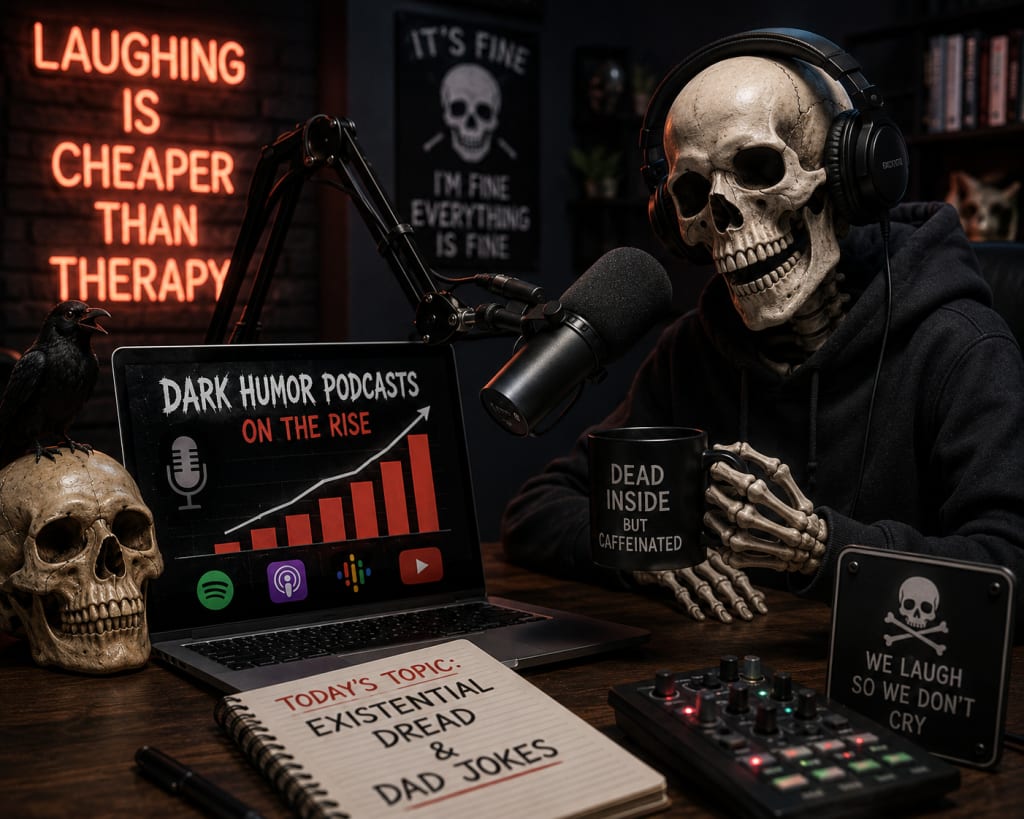
Dark Humor Podcasts Rising in Popularity
Comedy has always had a strange relationship with fear.
People laugh at pain they survived. They joke about disasters they cannot control. They turn awkward truths into punchlines. They use sarcasm when sincerity feels too exposed. They laugh at death, debt, dating, illness, office misery, political chaos, family trauma, and the absurdity of being alive in a world that rarely makes sense.
That is why dark humor podcasts are rising in popularity.
In 2026, listeners are not only looking for clean jokes, celebrity interviews, or light entertainment. Many are turning toward shows that mix comedy with uncomfortable subjects: true crime, mental health, death, social collapse, embarrassing personal stories, toxic workplaces, dating disasters, internet scandals, conspiracy culture, family dysfunction, and political absurdity. The tone is often sharp, inappropriate, self-aware, and morally risky. But when done well, dark humor podcasts give listeners something surprisingly valuable: a way to laugh without pretending everything is fine.
The broader podcast market is still growing. Edison Research’s Infinite Dial 2026 found that online audio listening in the U.S. reached an all-time high, with 81% of Americans age 12+ listening to online audio in the last month and 76% listening in the last week. The study also reported major growth among Americans age 55+, whose monthly online audio listening jumped from 52% in 2024 to 70% in 2026.
That expanding audience creates room for more niche formats. Comedy podcasts, true crime podcasts, horror podcasts, satire shows, and conversational podcasts are no longer fringe entertainment. They are part of daily routines: commuting, cooking, working out, cleaning, gaming, late-night scrolling, and trying to survive another exhausting week.
Dark humor sits right at the intersection of those habits.
It gives people comedy with teeth.
What Are Dark Humor Podcasts?
Dark humor podcasts are shows that use comedy to talk about serious, taboo, painful, frightening, or socially uncomfortable subjects.
They may cover death, crime, trauma, cults, disasters, politics, workplace misery, illness, bad relationships, apocalypse anxiety, or human stupidity. Some are scripted. Some are conversational. Some are hosted by comedians. Some are hosted by journalists, storytellers, true crime creators, therapists, internet personalities, or friends with very sharp mouths.
The tone can vary widely.
Some dark humor podcasts are clever and satirical.
Some are chaotic and offensive.
Some are deeply personal.
Some use jokes as a coping mechanism.
Some mix horror and comedy.
Some discuss true crime with comedic commentary.
Some roast modern culture.
Some explore conspiracy theories with sarcasm.
Some are basically emotional support groups disguised as inappropriate banter.
The common thread is that they laugh near the edge.
Not always over the edge.
But close enough to make listeners feel the tension.
Why Dark Humor Works So Well in Audio
Dark humor thrives in podcasting because audio feels intimate.
A dark joke in a written post can look cold. A dark joke on stage can feel confrontational. But in a podcast, tone carries nuance. Listeners hear hesitation, laughter, irony, discomfort, and chemistry between hosts. They can tell when a joke is meant as cruelty, self-defense, absurdity, or emotional relief.
That makes podcasts ideal for dark comedy.
The listener is not in a crowded theater. They are wearing headphones. The hosts feel like friends talking too honestly at midnight. That closeness allows dark topics to feel less performative and more human.
A podcast also has time. A 30-second clip can make a dark joke seem offensive without context. A 60-minute episode can build the emotional frame around it. Hosts can explain, backtrack, disagree, reflect, and show care. They can balance humor with empathy.
This is important because dark humor without context can easily become ugly.
Podcasting gives dark comedy the space it needs to breathe.
The True Crime Connection
One of the biggest reasons dark humor podcasts are rising is the continued popularity of true crime.
True crime has become one of podcasting’s strongest genres. Audiences are fascinated by mystery, danger, psychology, justice, and real-life horror. But true crime also creates emotional heaviness. Listening to story after story about murder, fraud, kidnapping, abuse, and corruption can become overwhelming.
Dark humor offers relief.
Some true crime podcasts use jokes carefully to release tension, usually making fun of criminals, police incompetence, absurd details, or the hosts’ own discomfort rather than victims. When done responsibly, humor can make grim material more listenable without disrespecting the people harmed.
The rise of video podcasting has also helped true crime comedy formats. The Daily Beast reported that true crime podcast Rotten Mango surged to the top of YouTube’s podcast rankings after its coverage of the Diddy trial, even knocking Joe Rogan from the top spot for a week. The report noted that several true crime shows appeared in the YouTube top ten, showing the genre’s strong pull on podcast audiences.
This matters because many dark humor podcasts borrow from true crime’s narrative tension while adding comedic commentary. The audience is already used to listening to frightening stories. Dark humor adds a pressure valve.
The key is responsibility.
Laughing at evil can be cathartic.
Laughing at victims is where the line breaks.
Why People Want Taboo Comedy Again
Dark humor is often a reaction against overly polished culture.
In professional life, people are expected to be careful. On social media, they are expected to be brand-safe. In public conversations, many feel pressure to say the right thing, avoid controversy, and present a clean emotional image. That can be exhausting.
Dark humor podcasts offer a different space.
They let people hear messy thoughts, uncomfortable jokes, unpopular feelings, and brutally honest commentary. The appeal is not always that listeners agree with every joke. Sometimes the appeal is simply that someone is saying what people are not supposed to say.
This does not mean audiences want cruelty for its own sake. The best dark humor is not just offensive. It is revealing. It exposes hypocrisy, fear, denial, and absurdity.
A good dark joke does not only shock.
It tells the truth from an angle polite language avoids.
That is why the format resonates in anxious times. When the world feels unstable, clean inspirational content can feel fake. Dark humor feels more honest because it admits that life is ridiculous, unfair, painful, and sometimes funny in the worst possible moments.
The Anxiety Economy
Dark humor podcasts are also growing because people are anxious.
War, inflation, political polarization, climate fear, job insecurity, AI disruption, loneliness, mental health stress, and nonstop bad news have created a culture of emotional overload. Many people do not want entertainment that pretends everything is beautiful. They want entertainment that acknowledges the chaos and makes it bearable.
Dark humor does that.
It says: yes, this is terrible.
Now let’s laugh before we lose our minds.
That is why many listeners use dark comedy podcasts almost like emotional regulation. They listen while commuting to stressful jobs, cleaning after long days, or lying awake at night. The show gives them companionship. It makes dread less lonely.
This is not new. Humor has always helped people survive hardship. Soldiers joke. Doctors joke. Funeral workers joke. Journalists joke. Parents joke. People in difficult professions often develop dark humor because it creates distance from unbearable realities.
Podcasts simply bring that coping mechanism into everyday entertainment.
The Role of Host Chemistry
Dark humor podcasts depend heavily on host chemistry.
A dark joke from the wrong person can feel mean. The same joke from a trusted host can feel like shared survival. That trust is built over time through tone, consistency, vulnerability, and moral boundaries.
Listeners need to feel that the hosts are not simply trying to be edgy. They need to sense intelligence behind the joke. They need to know the hosts understand the seriousness of the subject, even while laughing around it.
This is why many dark humor podcasts work best with two or more hosts. One host pushes the joke. Another reacts, questions, groans, corrects, or adds context. The conversation creates a moral balancing system.
A solo dark comedy show can work, but it requires strong self-awareness.
Without chemistry or self-control, dark humor can become lazy shock content.
With chemistry, it becomes a strange kind of intimacy.
Comedy, Horror, and the Same Nervous System
Dark humor podcasts often overlap with horror because laughter and fear are physically connected.
Both involve tension.
Both involve surprise.
Both involve release.
A horror story builds dread, then releases it through a scare. A joke builds expectation, then releases it through a punchline. That is why horror-comedy works so well. The body is already alert. Comedy gives it a way to exhale.
Podcasts about haunted stories, urban legends, paranormal mysteries, cults, disasters, and strange deaths often use dark humor to stop the material from becoming too heavy. Hosts may joke about their own fear, mock ridiculous decisions, or laugh at absurd supernatural logic.
This does not weaken the horror.
It can make it more enjoyable.
The listener gets both chills and relief.
That emotional rhythm is addictive.
Dark Humor and Mental Health
Dark humor podcasts also connect with mental health conversations.
Many hosts openly discuss anxiety, depression, therapy, trauma, addiction, burnout, family dysfunction, and existential dread through jokes. For some listeners, this feels more relatable than polished wellness advice. A host joking about panic attacks may make a listener feel seen in a way a motivational quote never could.
But there is a balance.
Dark humor can normalize difficult feelings, but it should not romanticize suffering or replace professional support. A joke about depression can be validating. A show that treats self-destruction as entertainment can become harmful.
The strongest dark humor podcasts understand the difference. They use comedy to reduce shame, not to glamorize pain. They make listeners feel less alone, not more hopeless.
The formula is delicate:
Acknowledge the darkness.
Laugh at the absurdity.
Leave room for care.
Why Gen Z and Millennials Respond Strongly
Younger audiences have grown up with irony as a survival language.
Memes about depression, student debt, climate anxiety, dating disasters, workplace burnout, and social awkwardness are everywhere. Gen Z and millennials often use humor to express feelings that might otherwise be too heavy or embarrassing to say directly.
Dark humor podcasts fit that communication style perfectly.
They are longer-form versions of the same emotional language: funny because it hurts, relatable because it is inappropriate, comforting because someone else gets it.
These audiences are also less attached to traditional broadcast formats. They are used to parasocial intimacy, niche creators, unfiltered commentary, and communities built around specific tones. A dark humor podcast does not need to appeal to everyone. It only needs to appeal deeply to the right audience.
That niche loyalty is powerful.
Listeners do not just consume the show.
They identify with its worldview.
The YouTube Podcast Effect
YouTube has changed podcast culture.
Many dark humor shows now release full video episodes, clips, shorts, reaction segments, and highlight reels. This makes them easier to discover through algorithms and social sharing. A dark joke clipped into a 45-second video can bring new listeners into a full episode.
YouTube’s growing role in podcast discovery also rewards personality-driven shows. Facial expressions, awkward pauses, laughter, and visual reactions make dark humor more understandable. A joke that might sound harsh in text can feel clearly ironic when viewers see the host’s face.
The Daily Beast’s report on YouTube’s podcast charts showed how true crime and comedy-driven personalities can compete strongly in podcast rankings, with YouTube becoming a major platform for podcast listeners.
This matters for dark humor because clips travel fast.
A single outrageous segment can become viral.
That helps growth.
But it also increases risk.
Dark humor taken out of context can create backlash.
The Backlash Problem
Dark humor always lives near controversy.
A joke may land with one audience and offend another. A clip may be shared without context. A host may cross a line. A victim’s family may feel hurt. A tragedy may be too recent. A political joke may become a culture-war flashpoint.
Entertainment Weekly recently reported on backlash after Pete Davidson made a dark joke during a Netflix roast referencing the assassination of conservative influencer Charlie Kirk. The team behind “The Charlie Kirk Show” called the joke distasteful while acknowledging broader debates about comedy and tragedy.
That incident shows the central tension of dark humor.
Comedy often pushes boundaries.
But timing, target, and context matter.
A joke about tragedy may be defensible to some and cruel to others. A joke made by someone close to pain may feel different from a joke made by an outsider. A joke targeting power may feel different from a joke targeting grief.
Dark humor podcasts must navigate this constantly.
The best ones know that “it’s just a joke” is not always enough.
Punching Up vs Punching Down
One of the most important rules in dark humor is target selection.
Dark jokes are more likely to work when they punch up: at powerful people, hypocrites, institutions, criminals, corrupt systems, absurd cultural norms, or the speaker’s own flaws.
They become uglier when they punch down: at victims, marginalized people, grieving families, people with disabilities, vulnerable communities, or people who are already suffering.
This is especially important in podcasting because hosts build long-term relationships with audiences. Listeners may forgive occasional bad jokes if they trust the host’s values. But repeated cruelty becomes the brand.
A dark humor podcast can be savage without being soulless.
That is the difference between smart dark comedy and cheap shock content.
The Best Dark Humor Is Not Random Cruelty
A common misunderstanding is that dark humor simply means saying horrible things.
It does not.
Good dark humor has structure. It has timing. It has a point. It exposes absurdity, contradiction, fear, or hypocrisy. It often works because it says what people are afraid to admit, not because it tries to hurt people randomly.
A lazy dark joke shocks.
A good dark joke reveals.
That difference matters in podcasts because listeners spend hours with hosts. Shock alone gets old quickly. What keeps people coming back is voice, perspective, honesty, and emotional intelligence.
The most successful dark humor podcasts usually combine:
Strong storytelling.
Sharp timing.
Host chemistry.
Clear moral instincts.
A recognizable worldview.
Willingness to be vulnerable.
Awareness of boundaries.
Without those elements, darkness becomes noise.
Advertisers Are More Cautious, But Audiences Are Loyal
Dark humor podcasts can be attractive to advertisers because they often build loyal audiences. Listeners feel close to hosts and may trust their recommendations. But the content can also be brand-risky.
Advertisers may hesitate if a show frequently covers death, crime, politics, sex, offensive jokes, or controversial topics. Platforms may also limit monetization around sensitive content.
This creates an interesting business problem.
Dark humor podcasts may grow fast, but they need careful monetization strategies: subscriptions, Patreon-style communities, live shows, merchandise, direct sponsorships, premium episodes, and listener support.
Comedy podcasting in general remains strong. Podcast industry lists and chart trackers continue to show comedy as one of the most active and popular categories, with many breakout shows gaining traction in 2026.
Dark humor shows benefit from that comedy boom but face a narrower advertising lane.
Their fans may love them because they are unfiltered.
Brands may fear them for the same reason.
Why Listeners Trust Dark Humor Hosts
Listeners often trust dark humor hosts because they seem less fake.
Traditional media can feel polished. Corporate content can feel sanitized. Wellness influencers can feel overly perfect. Dark humor hosts often sound flawed, exhausted, cynical, and honest. That imperfection creates credibility.
A host who admits they are anxious, petty, overwhelmed, or morally confused can feel more relatable than someone presenting a perfect life.
This does not mean dark humor hosts are always truthful or responsible. Some use “authenticity” as an excuse for cruelty. But when done well, the rawness creates a powerful bond.
The listener thinks:
They know life is messy.
They are not pretending.
They can laugh at the horrible parts.
That feeling builds loyalty.
Dark Humor as Social Satire
Many dark humor podcasts are not only personal. They are social satire.
They mock corporate culture, influencer absurdity, political hypocrisy, celebrity scandals, tech panic, wellness scams, dating apps, hustle culture, cancel culture, crime obsession, and internet outrage.
This makes them especially relevant in 2026 because the culture itself feels darkly comic. Every week brings strange headlines, public meltdowns, AI controversies, legal scandals, viral workplace stories, and political theater that already feel like satire.
Dark humor podcasts help process that absurdity.
They become a weekly filter for chaos.
Instead of asking listeners to calmly analyze everything, they say:
This is insane. Let’s talk about why.
That tone can be deeply satisfying.
The Difference Between Dark Humor and Misinformation
There is one serious risk: dark humor can blur with misinformation if hosts are careless.
When podcasts discuss crime, politics, conspiracy theories, health, or public figures, jokes can accidentally spread false claims. A sarcastic exaggeration may be repeated as fact. A speculative comment may become a viral clip. A darkly comic conspiracy segment may attract people who believe it literally.
Responsible dark humor hosts should distinguish between verified facts, rumors, jokes, and personal opinions.
This is especially important for true crime and political comedy.
Listeners may tune in for laughs, but real people and real consequences are involved. Accuracy still matters.
A podcast can be dark and funny without being sloppy.
In fact, the best ones are often better because they do their homework.
Why the Format Will Keep Growing
Dark humor podcasts will likely keep growing because they fit modern listening habits perfectly.
They are intimate.
They are niche.
They are bingeable.
They are clip-friendly.
They feel honest.
They combine entertainment with emotional release.
They work across comedy, true crime, horror, politics, and personal storytelling.
They give listeners a way to laugh at the things that scare them.
As podcast consumption continues to rise, more creators will experiment with darker tones. Some will succeed because they understand nuance. Others will fail because they confuse cruelty with comedy.
The audience is there.
The challenge is doing it well.
What Makes a Great Dark Humor Podcast?
A great dark humor podcast usually has more than shocking jokes.
It needs a strong point of view. The hosts must understand what they are laughing at and why. It needs empathy, even when the humor is savage. It needs pacing, because constant darkness becomes exhausting. It needs research if it covers real events. It needs chemistry if it is conversational. It needs boundaries, because comedy without judgment can become harm.
Most importantly, it needs humanity.
The best dark humor does not deny pain.
It sits beside it and says, somehow, we are still laughing.
That is why people listen.
Not because they do not care.
Because sometimes laughing is how caring people survive.
Final Verdict
Dark humor podcasts are rising in popularity because they match the emotional mood of the moment. Audiences are overwhelmed by anxiety, bad news, workplace stress, political chaos, true crime obsession, and social-media absurdity. Clean escapism still has its place, but many listeners want comedy that admits life can be frightening, unfair, ridiculous, and painful.
The broader podcast market is growing, with Edison Research’s Infinite Dial 2026 showing online audio listening at record levels in the United States. At the same time, true crime and comedy-driven podcast formats continue to perform strongly on platforms like YouTube, helping darker, personality-led shows reach bigger audiences.
The appeal is clear. Dark humor podcasts offer companionship, catharsis, satire, and taboo honesty. They let people laugh at fear without pretending fear is not real.
But the format comes with responsibility. The best dark humor punches up, respects victims, understands timing, and knows the difference between a painful truth and a cheap shot.
Dark humor podcasts are not popular because the world has become heartless.
They are popular because the world feels heavy.
And sometimes, the only way to carry the darkness is to laugh at it before it carries you.